
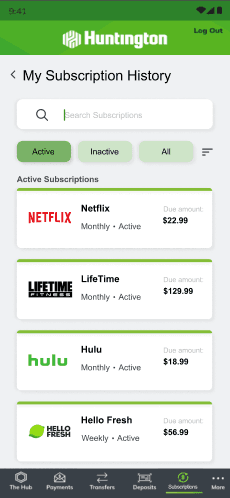
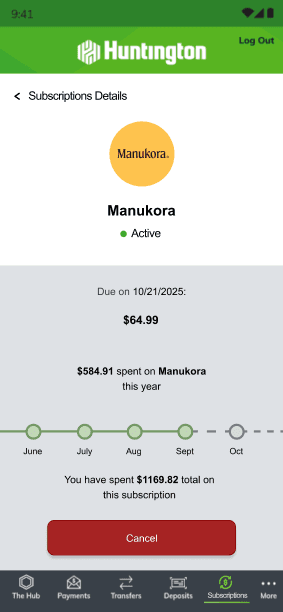
Iterative Refinement Due to Usability Testing
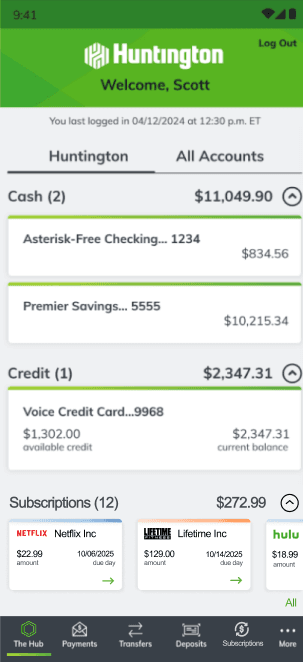
Surfaced recurring subscriptions as a distinct module within the dashboard
Prioritized subscription cost and billing cycle information to support faster recognition of recurring charges
Introduced entry points into subscription details to centralize management actions
Initial High-Fidelity Direction
Reduced visual density to improve scanability of active subscriptions
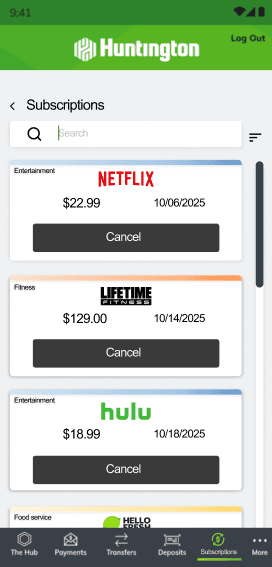
Changed colors of cancel button to create a clearer primary action hierarchy
Increased spacing between billing details and brand elements to support financial clarity
Introduced filtering elements for easier maneuverability
1. Dashboard Subscription Module
Key Design Decisions
After
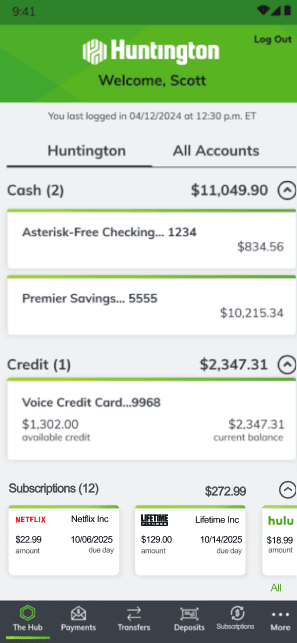
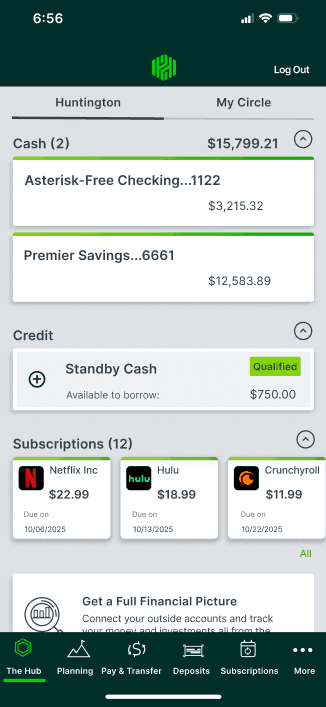
Recurring subscriptions are surfaced as a dedicated dashboard module for quick identification.
Before
Users had to manually search through individual account transactions to identify recurring charges.
2. Centralized Subscription List
After
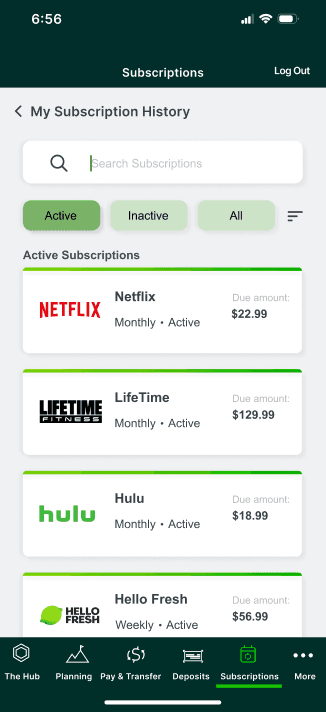
A dedicated subscriptions page allows users to view, filter, and search recurring services.
Before
Users lacked a single location to review all active subscriptions.
3. Detailed Subscription Management
After
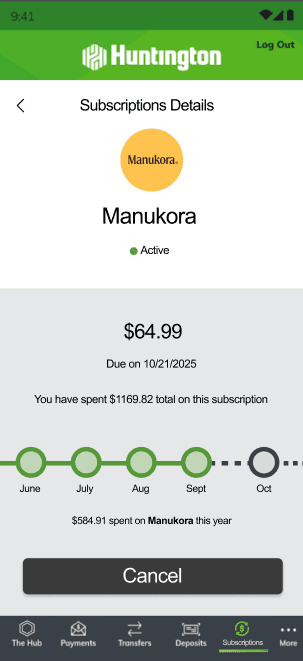
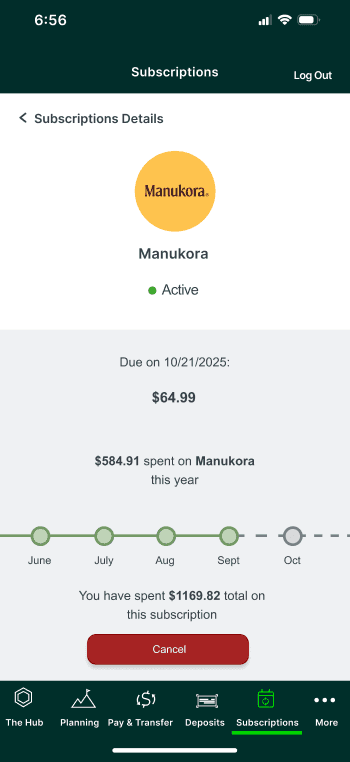
A detailed view displays billing amount, subscription duration, and cumulative spend over time.
Users had limited visibility into subscription duration or total spent.
4. Multiple Management Entry Points
After
Users can cancel subscriptions directly from either the dashboard or detailed view.
Before
Cancellation required navigating through transaction histories.
Before
The following design decisions were introduced to improve subscription visibility, simplify navigation, and support more confident management of recurring expenses. By reducing user fatigue and increasing transparency around ongoing financial commitments this would encourage greater engagement with in-app financial management tools.
SOLUTION & IMPACT
Subscription Management Through Centralized Controls
The following interface screens reflect how these design decisions were implemented to support clearer visibility and more confident management of recurring financial commitments.
Final Thoughts
M
L
J
z
Subscription Management is Hard
OVERVIEW
PROBLEM
This project introduces an intuitive, transparent system that helps customers understand, track, and manage recurring payments directly within the Huntington app.
How can we help Huntington users easily track, understand, and manage recurring subscriptions with more clarity and control?
My Roles
Tools
UX Design
UX Research
Information Architecture
Figma
Google Docs
Notion
Timeline
12 Weeks
Users underestimate & overlook
recurring charges
The average consumer now holds around 12 paid subscriptions, and 74% underestimate how much they spend monthly.
Users lack a simple, centralized view of recurring expenses
Nearly half of consumers (47%) have forgotten at least one recurring subscription
How Users Manage Subscriptions Today and How Huntington Compares to Competitors
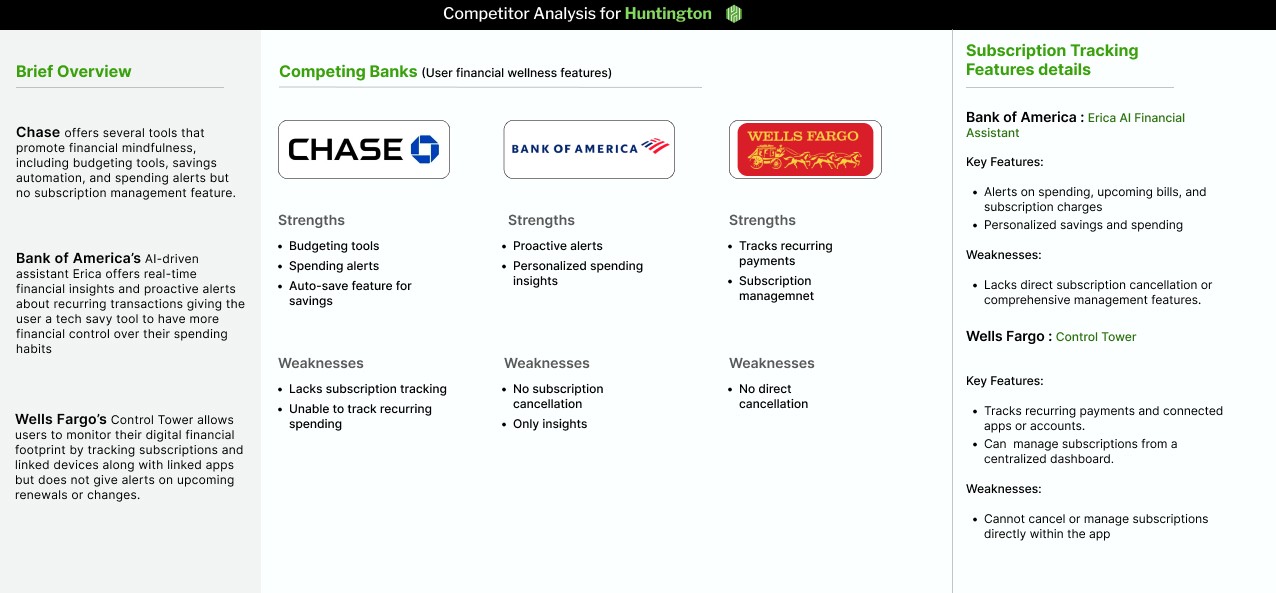
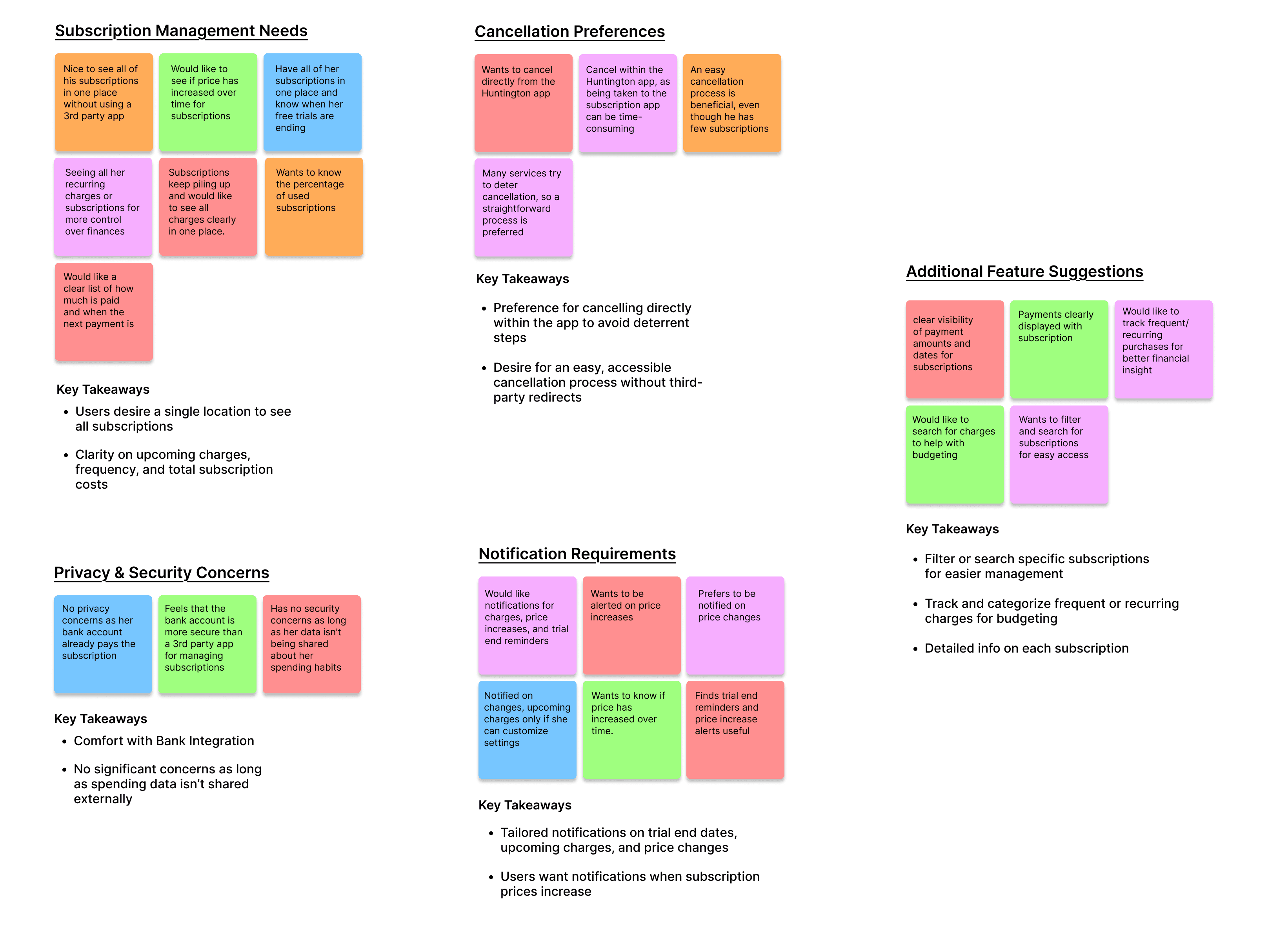
To validate the problem and shape the feature, I conducted a competitive analysis and ran five one-on-one semi-structured interviews with Huntington customers who pay for multiple digital subscriptions.
Competitive Analysis
Affinity Map
*I reviewed tools offered by Chase, Bank of America, and Wells Fargo to understand how competitors support recurring expense visibility and what gaps Huntington could address.
*Synthesized interview data into themes around how users remember, track, and manage subscription charges.
RESEARCH & FINDINGS
Strengthening Financial Awareness by Simplifying Subscription Management
Users Lack a Single Place to See All Their Subscriptions
01
Many participants tracked subscriptions across email, bank statements, and mental notes.
“I just scroll my statements and hope I didn’t miss anything.”
Putting Everything Together, Here's What Stood Out:
Users Want Clarity on Renewal Dates & Price Changes
02
Users struggled to remember when subscriptions renew and were often unaware of price increases
“I wish I knew ahead of time when something was going to renew or go up.”
Competitors Surface Insights, but Lack Full Management
03
Competing banks offer spending insights and subscription detection, but do not provide comprehensive tools for managing, canceling, or centralizing subscriptions.
Users Value Simplicity & Don’t Want Feature Overload
05
“Just show me what I have and what I’m paying don’t make it complicated.”
Users Want More Control, Not Just Awareness
04
“I hate having to hunt down where to cancel something… I wish it was all in one place.”
Research Shaped a Polished Experience
PROCESS
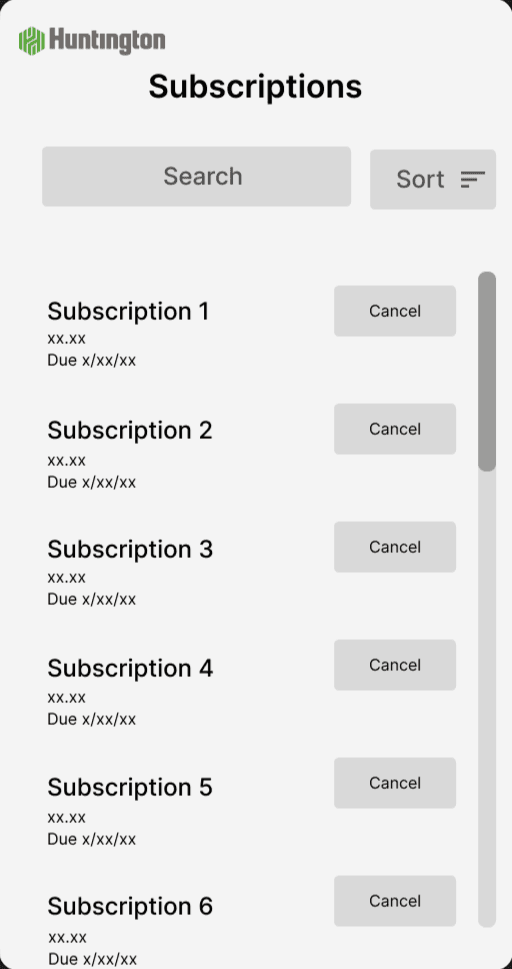
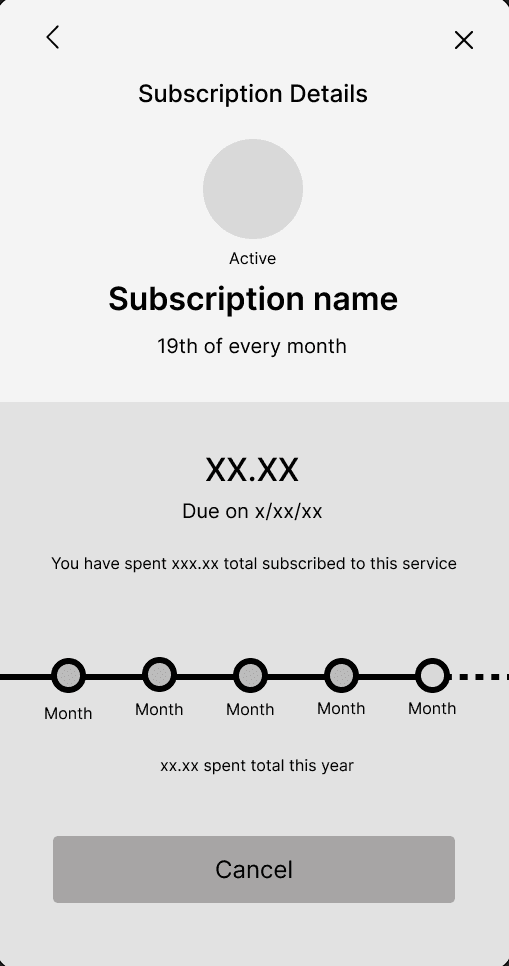
I began by translating research insights into quick low-fi and mid-fi concepts to explore how subscription management could feel simpler and more calming for Huntington users.
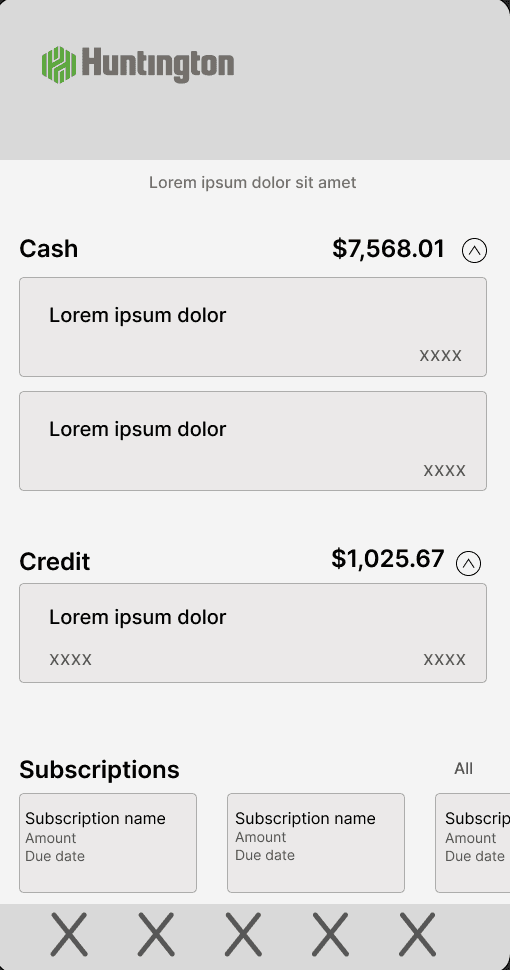
Dashboard Overview
Subscription List
Subscription Details
Mid-fidelity wireframes focused on structure, hierarchy, and core actions before visual refinement
After validating the core flow and information hierarchy, I moved into high-fidelity exploration to refine visual clarity, emotional tone, and brand alignment while taking into note design changes recommended by testers of the first version.
High-Fidelity Exploration & Iteration

Visibility Supports Financial Confidence
As I progressed through this project, I found that introducing financial management tools requires balancing visibility with user confidence. In the context of subscription oversight, I found that surfacing recurring expenses needed to be done in a way that supported intuitive interaction without overwhelming user decision-making. Designing for financial management reinforced the importance of simplicity, where actions must remain accessible and understandable to encourage user engagement.
Designing for Confident Financial Decisions
Key Learnings
Providing users with clearer billing information and spend timelines may reduce hesitation when managing recurring financial commitments.
Centralized Management Reduces Cognitive Load
Consolidating subscription oversight into a single flow can simplify decision-making and improve engagement with in-app financial tools.
CASE STUDY
Huntington
Subscription Management Tool

© 2026 Kauthar Moussaid · Designed & Built in Framer
Huntington
CASE STUDY
Subscription Management
Tool
Strengthening Financial Awareness by Simplifying Subscription Management
OVERVIEW
My Roles
Tools
Timeline
UX Design
UX Research
Information
Architecture
Figma
Google Docs
Notion
12 Weeks
This project introduces an intuitive, transparent system that helps customers understand, track, and manage recurring payments directly within the Huntington app.
PROBLEM
Subscription Management is Hard
How can we help Huntington users easily track, understand, and manage recurring subscriptions with more clarity and control?
Users underestimate & overlook
recurring charges
The average consumer now holds around 12 paid subscriptions, and 74% underestimate how much they spend monthly.
Users lack a simple, centralized view of recurring expenses
Nearly half of consumers (47%) have forgotten at least one recurring subscription
RESEARCH & FINDINGS
How Users Manage Subscriptions Today and How Huntington Compares to Competitors
To validate the problem and shape the feature, I conducted a competitive analysis and ran five one-on-one semi-structured interviews with Huntington customers who pay for multiple digital subscriptions.
Competitive Analysis
*I reviewed tools offered by Chase, Bank of America, and Wells Fargo to understand how competitors support recurring expense visibility and what gaps Huntington could address.
Affinity Map
*Synthesized interview data into themes around how users remember, track, and manage subscription charges.
Putting Everything Together, Here's What Stood Out:
01
Users Lack a Single Place to See All Their Subscriptions
Many participants tracked subscriptions across email, bank statements, and mental notes.
“I just scroll my statements and hope I didn’t miss anything.”
02
03
04
05
Users Want Clarity on Renewal Dates & Price Changes
Competitors Surface Insights, but Lack Full Management
Users Want More Control, Not Just Awareness
Users Value Simplicity & Don’t Want Feature Overload
Users struggled to remember when subscriptions renew and were often unaware of price increases
Competing banks offer spending insights and subscription detection, but do not provide comprehensive tools for managing, canceling, or centralizing subscriptions.
“I wish I knew ahead of time when something was going to renew or go up.”
“Just show me what I have and what I’m paying don’t make it complicated.”
“I hate having to hunt down where to cancel something… I wish it was all in one place.”
Research Shaped a Polished Experience
PROCESS
I began by translating research insights into quick low-fi and mid-fi concepts to explore how subscription management could feel simpler and more calming for Huntington users.
Dashboard Overview
Subscription List
Subscription Details
Mid-fidelity wireframes focused on structure, hierarchy, and core actions before visual refinement
High-Fidelity Exploration & Iteration
After validating the core flow and information hierarchy, I moved into high-fidelity exploration to refine visual clarity, emotional tone, and brand alignment while taking into note design changes recommended by testers of the first version.
Initial High-Fidelity Direction
Surfaced recurring subscriptions as a distinct module within the dashboard
Prioritized subscription cost and billing cycle information to support faster recognition of recurring charges
Introduced entry points into subscription details to centralize management actions
Iterative Refinement due to Usability testing
Introduced filtering elements for easier maneuverability
Increased spacing between billing details and brand elements to support financial clarity
Changed colors of cancel button to create a clearer primary action hierarchy
Reduced visual density to improve scanability of active subscriptions
SOLUTION & IMPACT
Subscription Management Through Centralized Controls
The following design decisions were introduced to improve subscription visibility, simplify navigation, and support more confident management of recurring expenses. By reducing user fatigue and increasing transparency around ongoing financial commitments this would encourage greater engagement with in-app financial management tools.
Key Design Decisions
Before
1. Dashboard Subscription Module
After
Users had to manually search through individual account transactions to identify recurring charges.
Recurring subscriptions are surfaced as a dedicated dashboard module for quick identification.
Before
After
2. Centralized Subscription List
Users lacked a single location to review all active subscriptions.
A dedicated subscriptions page allows users to view, filter, and search recurring services.
3. Detailed Subscription Management
Before
After
Users had limited visibility into subscription duration or total spent.
A detailed view displays billing amount, subscription duration, and cumulative spend over time.
4. Multiple Management Entry Points
Before
After
Cancellation required navigating through transaction histories.
Users can cancel subscriptions directly from either the dashboard or detailed view.
The following interface screens reflect how these design decisions were implemented to support clearer visibility and more confident management of recurring financial commitments.
FINAL THOUGHTS
Consolidating subscription oversight into a single flow can simplify decision-making and improve engagement with in-app financial tools.
Key Learnings
Designing for Confident Financial Decisions
As I progressed through this project, I found that introducing financial management tools requires balancing visibility with user confidence. In the context of subscription oversight, I found that surfacing recurring expenses needed to be done in a way that supported intuitive interaction without overwhelming user decision-making. Designing for financial management reinforced the importance of simplicity, where actions must remain accessible and understandable to encourage user engagement.
Centralized Management Reduces Cognitive Load
Visibility Supports Financial Confidence
Providing users with clearer billing information and spend timelines may reduce hesitation when managing recurring financial commitments.